
Calling healthcare staff
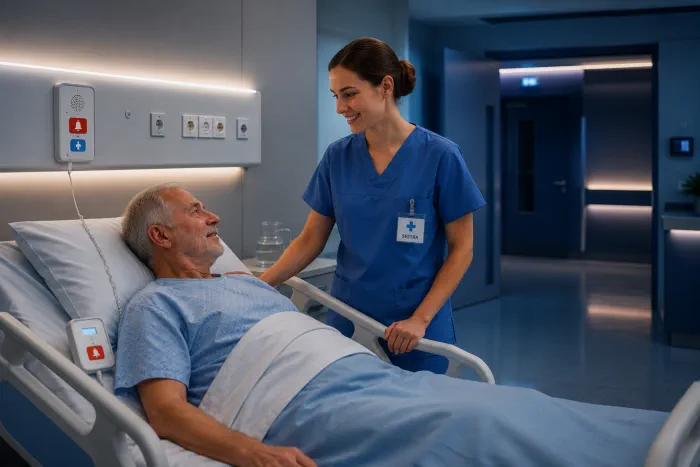
The patient can call a nurse easily from the bed, room, bathroom or another location using a call button, pendant handset or hospital terminal.
HEALTHCARE COMMUNICATION SYSTEMS
A nurse call system provides fast, safe and reliable communication between patients and healthcare staff. It enables an immediate call for assistance, two-way voice communication, event prioritisation and routing to nursing stations or mobile communication devices.
The modern IP solution is designed for hospitals, clinics, residential care facilities and other healthcare environments. It supports event logging, gradual expansion and integration with Hospital Information Systems (HIS), Real-Time Location Systems (RTLS), Building Management Systems (BMS) and other hospital infrastructure technologies.
MODERN COMMUNICATION
A nurse call system (Nurse Call) is an intelligent healthcare communication system that provides immediate communication between the patient and healthcare staff. It enables the patient to call for assistance easily and gives staff reliable information about the location, type and priority of the event.
Modern IP systems are far more than a call button beside the patient’s bed. They support two-way voice communication, call prioritisation and escalation, signalling at nursing stations, mobile notifications and detailed event logging.
Thanks to their modular architecture and integration capabilities, nurse call systems form part of the digital infrastructure of hospitals, clinics, residential care facilities, rehabilitation centres and long-term care facilities.
KEY FUNCTIONS
A modern nurse call system connects patients with healthcare staff and provides reliable processing, signalling, prioritisation and logging of all events.
The patient can call a nurse easily from the bed, room, bathroom or another location using a call button, pendant handset or hospital terminal.
Patients and healthcare staff can communicate directly through room or bedside terminals without requiring the nurse to attend the bedside immediately.
Different call devices make the system available at the patient’s bedside, in the room, bathroom, toilet and other areas of the healthcare facility.
Calls and events are displayed at staff workstations with information about the room, bed, event type and current status.
The system distinguishes routine, urgent and emergency events. If a call is not acknowledged within the defined time, it can be forwarded automatically to another staff member or team.
All calls, acknowledgements, response times and event completions can be recorded for operational supervision, evaluation and workflow optimisation.
HOW IT WORKS
The nurse call system provides fast and controlled transfer of a patient request from the call device to the appropriate healthcare worker. Each event can be identified, prioritised, acknowledged and recorded.
The patient activates a call using a bedside control, room button or call device in the bathroom or toilet.
The system identifies the call location, room, bed and event type. Depending on the configuration, it assigns the appropriate priority.
The event is displayed at the nursing station and can also be sent to mobile devices, DECT handsets or other staff communication terminals.
A healthcare worker acknowledges the call and, depending on the terminal type, can establish two-way voice communication with the patient.
When staff arrive, the event is closed. The system can record the call, acknowledgement, response and completion times for subsequent operational evaluation.
APPLICATION AREAS
A nurse call system is suitable wherever reliable communication between patients and healthcare staff, rapid response to events and safe organisation of care are required.
Comprehensive communication between patients and healthcare staff in inpatient wards, intensive care units, operating departments and specialist wards.
Effective communication between patients and staff in outpatient and inpatient departments, with an emphasis on rapid response and patient safety.
Calling for assistance, event signalling and improved safety for older people and individuals requiring round-the-clock care.
Safe calling of healthcare staff during rehabilitation and subsequent patient care.
The communication system enables an immediate call for staff, improves work organisation and increases patient comfort during hospitalisation.
Reliable communication between patients and staff helps provide rapid assistance, greater comfort and higher-quality care.
SYSTEM CAPABILITIES
Modern nurse call systems offer far more than call signalling. Their modular IP architecture allows individual functions to be tailored to the requirements of a specific healthcare facility—from standard inpatient wards to intensive care units.
Modern patient terminals support calls to healthcare staff, voice communication, room controls and, depending on the configuration, multimedia services for patients.
Room terminals provide communication between patients and staff, manage call signalling and display information about the status of individual events.
The nursing station displays all active calls, their priority, source location and current status. Staff maintain a continuous overview of the situation on the ward.
Events can be routed to mobile devices, DECT handsets or SIP telephony, reducing healthcare staff response times.
The system distinguishes routine, service, assistance and emergency calls. If an event is not acknowledged, it can be escalated automatically to another staff member.
The communication system uses TCP/IP and Ethernet, supports PoE and enables integration with Hospital Information Systems (HIS), RTLS, Building Management Systems (BMS) and other technologies.
KEY BENEFITS
A modern healthcare communication system improves patient safety, supports more efficient staff organisation and provides a better overview of all events on the ward. The result is higher-quality care and greater patient comfort.
An immediate call for assistance reduces healthcare staff response times and improves patient safety in both routine and urgent situations.
Automatic routing, prioritisation and escalation of calls help healthcare staff respond more quickly and organise day-to-day ward operations more effectively.
Every call, acknowledgement and event completion can be recorded and subsequently evaluated to improve the quality of care provided.
The modular IP architecture allows the system to be expanded gradually as the healthcare facility’s needs evolve, without major changes to the existing infrastructure.
The system can be connected to a Hospital Information System (HIS), RTLS, Building Management Systems (BMS), DECT telephony and other technologies.
The open IP platform provides a long-term perspective, straightforward modernisation and readiness for the continued development of digital hospital technologies.
COMPREHENSIVE SOLUTION
Modern healthcare facilities require more than reliable calls to healthcare staff. A healthcare communication system combines patient communication, the location of people and equipment, Hospital Information Systems and other technologies within one integrated solution.
The foundation of the healthcare communication system, providing immediate calls to healthcare staff, voice communication and event signalling.
Connectivity with the Hospital Information System (HIS), Building Management Systems (BMS), telephony, DECT, signalling systems and other healthcare facility technologies.
Learn more about integration →Real-time location of patients, healthcare staff and medical equipment helps improve safety and organise operations more efficiently.
Learn more about RTLS →A modular IP platform from Schrack Seconet that forms the foundation of modern healthcare communication systems and supports their continued expansion.
Learn more about Visocall IP →WHY SYMATEC
A healthcare communication system is a critical part of healthcare infrastructure. It is therefore important to choose a partner that provides not only the technology but also specialist solution design, professional implementation and reliable support throughout the system’s service life.
We prepare every project according to the needs of the specific healthcare facility, taking into account its operations, capacity, organisational structure and opportunities for future development.
We supply modern, proven technologies from reputable manufacturers that meet the requirements for reliability, safety and long-term operation in healthcare facilities.
We provide complete delivery—from project planning, installation and configuration to commissioning, user training and final handover.
We design solutions ready to communicate with HIS, BMS, fire alarm systems, RTLS, DECT, SIP telephony and other systems used in modern hospitals.
After commissioning, we provide regular maintenance, technical support, diagnostics, modernisation and long-term service to ensure reliable system operation.
Our goal is not only to deliver the project but to build a long-term partnership based on expertise, reliability and high-quality services throughout the life of the healthcare communication system.
TECHNICAL FEATURES
A modern nurse call system must meet high requirements for reliability, safety, flexibility and future scalability. Its IP architecture enables simple management, integration with other technologies and gradual system expansion according to the healthcare facility’s needs.
Communication over a standard Ethernet network (TCP/IP) enables straightforward installation, management and expansion without building a separate communication infrastructure.
Individual wards, beds, workstations or entire buildings can be added gradually without replacing the existing system, reducing investment costs during future expansion.
The decentralised architecture minimises the risk of outages and ensures reliable operation even in extensive healthcare communication systems.
Modern IP solutions support secure communication, user permission management and protection of system and operational data in healthcare environments.
Support for standard communication protocols enables integration with the Hospital Information System (HIS), RTLS, DECT and SIP telephony, Building Management Systems (BMS), fire alarm systems and other technologies.
The system is designed so that new functions, terminals, mobile applications, location services and other intelligent technologies can be added without major changes to the existing infrastructure.
FAQ
Answers to common questions about nurse call systems, healthcare communication, voice connectivity, event signalling, IP technology and hospital systems integration.
A nurse call system is a healthcare communication system that enables patients to call healthcare staff quickly and easily from the bed, room, bathroom, toilet or another location within a healthcare facility. A modern nurse call system also supports voice communication, event signalling, call management and response-time logging.
The patient can activate a call using a bedside control, handheld call button, patient terminal, room unit or emergency button located in the bathroom or toilet. The system then identifies the call location and sends the information to the nursing station.
Depending on the configuration, the system can distinguish a standard nurse call, assistance call, emergency call, service call, bathroom or toilet call, staff presence and other event types. Different priorities and escalation procedures can be assigned to individual calls.
Yes. Selected patient, bedside and room terminals enable two-way voice communication between the patient and healthcare staff. Staff can therefore assess the patient’s request before entering the room.
Nurse call systems are used in hospitals, clinics, outpatient centres, long-term care hospitals, rehabilitation facilities, hospices, residential care homes, senior care facilities and other health and social care environments.
The central nursing station or touchscreen terminal displays active calls, their source location, room or bed number, event type, priority and current status. Staff therefore have an overview of all requests on the ward.
Yes. Depending on the configuration, call and event information can be routed to mobile terminals, DECT handsets, SIP telephony or other communication devices used by healthcare staff. This reduces response times and improves staff availability.
Yes. The healthcare communication system can be integrated with a Hospital Information System (HIS), RTLS technologies, a Building Management System (BMS), DECT and SIP telephony, fire alarm systems and other hospital or security technologies.
Yes. The modular IP architecture allows individual wards to be modernised gradually and the scope of the solution to be adapted to existing cabling, network infrastructure and the operational possibilities of the healthcare facility.
Yes. New wards, bedside and room terminals, nursing stations, mobile devices, voice communication, RTLS and additional integration modules can be added gradually without replacing the entire solution.
An IP architecture using Ethernet and TCP/IP provides simpler management, flexible expansion, remote diagnostics and improved integration options. Depending on the solution, PoE power and decentralised system components can also be used.
Yes. SYMATEC provides consultation, specialist design, project planning, technology supply, installation, configuration, commissioning, user training, regular maintenance and long-term support for the healthcare communication system.
SYMATEC supplies healthcare communication solutions including Visocall IP from Schrack Seconet. It is a modular platform designed for nurse call, voice communication, event signalling, hospital systems integration and the continued development of healthcare facilities’ digital infrastructure.
CONSULTATION AND SOLUTION DESIGN
We will help you prepare a reliable solution for a hospital, clinic, long-term care facility, rehabilitation centre, hospice or residential care home. We provide specialist consultation, healthcare communication system design, project planning, technology supply, installation, configuration, commissioning and ongoing maintenance.
We tailor the solution to the number of wards and beds, the required call signalling, voice communication, mobile terminals and integration with HIS, RTLS, DECT, SIP, BMS and other healthcare facility technologies.