
Immediate visibility
Current location of patients, staff and tracked equipment within the hospital building.
RTLS provides an immediate overview of the location of people and equipment within a hospital. It helps protect patients, improve staff safety, reduce time spent searching for equipment and manage healthcare operations more efficiently.
The location system connects positioning data with everyday hospital processes. Staff can respond more quickly, find the required equipment more easily and better protect both patients and employees.
Current location of patients, staff and tracked equipment within the hospital building.
Geofencing, duress alarms and rapid display of the location of a person who needs assistance.
Find a bed, infusion pump, trolley or other device without spending time searching across wards.
Integration with Nurse Call, HIS, mobile applications and other hospital technologies.
Movement history and equipment-utilisation data support the optimisation of logistics and workflows.
The solution can begin on one ward and expand to additional workplaces or the entire campus as required.
Equipment moves between wards, patients leave their rooms and staff work throughout large, complex buildings. Without location data, responses can be unnecessarily slow.
An infusion pump, wheelchair or available bed may be nearby, but staff do not know where it is.
A patient at risk of disorientation may leave a safe area without staff noticing immediately.
An alarm alone may not be enough. When a staff member is at risk, knowing where the event is taking place is critical.
Without data on equipment movement and utilisation, purchasing, maintenance and optimal placement are more difficult to plan.
During an urgent event, staff may lose time determining who is closest and able to respond.
Without objective data, processes are harder to optimise and decisions often rely only on estimates.
RTLS, or Real-Time Location System, is a technology for real-time positioning. Electronic tags, location infrastructure and central software determine the location of tagged people or objects.
Hospital staff can use a map or application to identify the ward, room or location zone in which the required person or object is located.
RTLS is more than a map with moving points. Location data can support automatic alarms, geofencing, equipment searches, duress calls, equipment-utilisation analysis and integration with other systems.
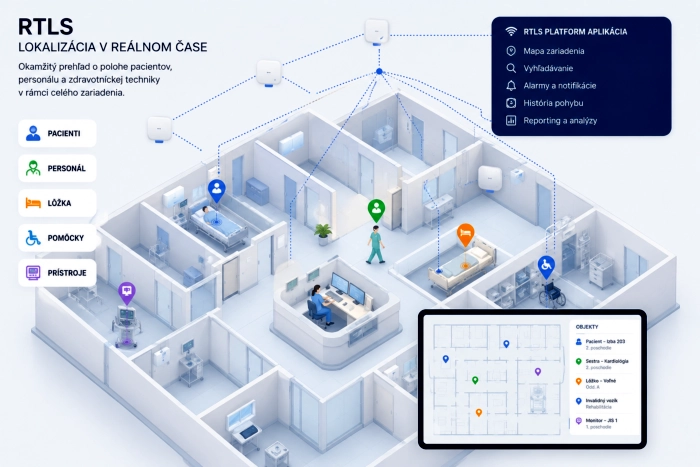
The technical solution is tailored to the building, required accuracy and type of people or equipment being tracked. The basic principle, however, remains similar.
A patient, staff member or device is fitted with an electronic identifier.
Receivers, beacons or readers detect communication from the tag within the covered area.
The RTLS platform evaluates the received data and assigns the object to its current room or location zone.
The system evaluates rules, safety zones, duress calls and other configured scenarios.
Information is displayed to the user or sent to Nurse Call, a mobile application or another system.
There is no single universal technology for every project. The appropriate solution depends on the building, operational scenarios, required accuracy, infrastructure and tag-maintenance strategy.
An energy-efficient wireless technology suitable for locating people, mobile aids and medical equipment.
A technology suitable for asset identification, movement records and detecting passage through a defined checkpoint.
A solution for applications requiring highly accurate positioning within a room or defined area.
Depending on the infrastructure used, an existing wireless network can support approximate location determination.
Each object type can have its own rules, permissions, alarms and display method. The hospital therefore receives a solution tailored to specific workflows.
Protection of at-risk patients, monitoring of safety zones and rapid location within the workplace.
Location during a duress call, team coordination and identification of available staff.
Visibility of mobile-bed locations during transfers between rooms, wards and service areas.
Easier location of mobility aids and a clearer overview of availability across the hospital campus.
Rapid location of the required pump and data supporting more efficient use of medical equipment.
Location of monitors, defibrillators and other mobile devices according to workplace needs.
The system can be tailored to different departments. Each workplace uses location data differently—from patient protection to efficient medical-equipment management.
Rapid equipment location and better staff coordination during time-critical events.
Visibility of devices, beds and equipment movement in an environment with high availability requirements.
Location of specialised equipment and support for organising equipment movement between workplaces.
Patient protection, location of aids and more efficient management of everyday operational tasks.
Geofencing and alerts when a patient at risk of disorientation leaves a safe zone.
Client supervision, support for rapid staff response and protection of people with impaired orientation.
The real value of RTLS comes from combining location, time, object identity and the operational scenario.
Display of the current location of a person or device within a supported building, room or zone.
Automatic notification when entering a protected area or leaving a defined safety zone.
When activated, a personal tag can send an alarm together with the user’s current location.
With a suitable device, unusual immobility or a staff member’s fall can be detected.
An authorised user can analyse recorded events and the movement of selected objects.
Search for mobile assets and view their location, availability or movement between wards.
RTLS can operate as a standalone solution, but its greatest potential is achieved through integration with other hospital technologies.
Location information can supplement a Nurse Call alarm, a staff duress call, a mobile notification or a workflow connected to the Hospital Information System.
The connection method depends on the technical capabilities of the systems involved. Available APIs, standardised interfaces or an integration platform can be used.
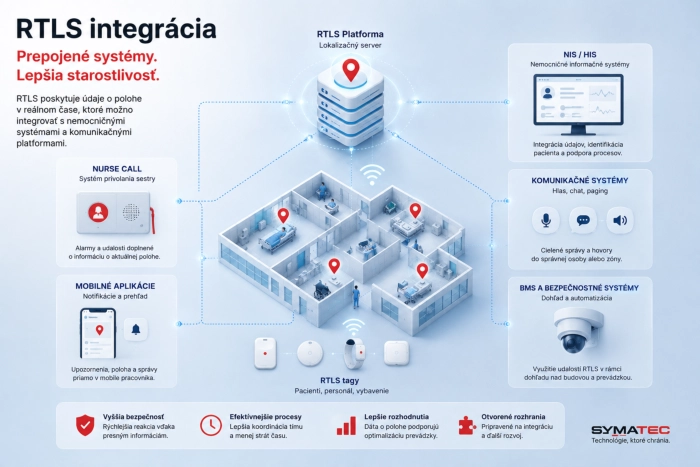
Add the current location of a patient or staff member to an alarm or duress call.
Connect location data with authorised hospital processes and identification data.
Display a notification, alarm or location directly to a staff member on a supported mobile device.
Use RTLS events within broader supervision of the building, operations and safety processes.
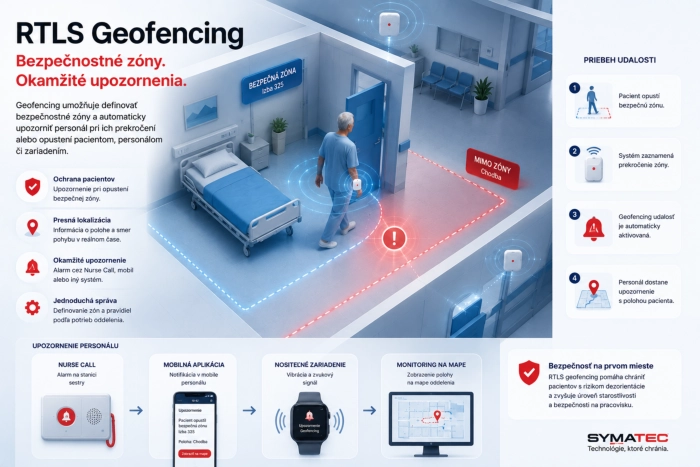
Permitted areas can be defined for a selected patient, such as a room, ward or designated part of the facility.
When the patient crosses the boundary of the safety zone, RTLS evaluates the event automatically and sends an alert to the designated staff.
The information can include event identification, time, last known location and other data needed for a rapid and appropriate response.
The location system records the movement of the tagged patient.
The patient leaves the area defined as safe.
RTLS automatically creates a geofencing event.
An authorised staff member receives information about the event and the last known location.
Staff can respond directly without unnecessarily searching the entire workplace.
Mobile medical devices move during the day between rooms, wards, stores, service areas and spaces designated for cleaning or disinfection.
RTLS allows an authorised user to find a specific infusion pump, monitor, trolley or bed and display its last known location.
Movement history and utilisation data can also support decisions about equipment placement, service intervals and future investment.
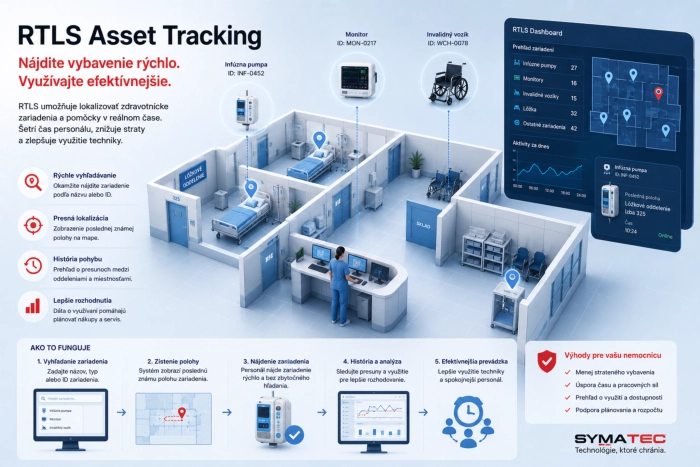
The user searches for a device by name, type, identifier or another permitted data field.
The system displays the ward, room or zone in which the device was last detected.
Event records help analyse equipment movement and resolve operational discrepancies.
Data can reveal equipment that is overused, underused or poorly located.
Location services support daily processes, whether locating equipment, protecting a patient or helping a staff member in distress.
A staff member begins the shift and the personal tag is ready to issue a duress call with location information.
Staff search for an available pump and identify the ward or room in which it is located.
A patient crosses a safety-zone boundary and the system sends an automatic alert.
A healthcare worker activates the button and colleagues receive an alarm together with location information.
An authorised user analyses the movement and utilisation of tracked equipment.
A high-quality RTLS solution begins with an understanding of workflows. The technology itself must suit the building, required accuracy and intended use.
We define the objects to be tracked, safety scenarios, required accuracy and expected integrations.
We assess the layout, construction conditions, existing infrastructure and operational constraints.
We select the technology and design the coverage, functions, devices and integration method.
We prepare technical documentation and coordinate with other disciplines and hospital systems.
We install the infrastructure, configure the platform and implement the agreed system connections.
We verify coverage, alarm scenarios and user roles, and train staff to use the system.
We provide support, maintenance and further development as workplace needs evolve.
Automatic alerts when a safe zone is left support a faster staff response.
A duress call with location information helps direct assistance more precisely.
Staff can focus on care instead of spending time searching for medical equipment.
Location and usage visibility support more efficient placement and purchasing decisions.
Current location data provides staff with the specific information needed to respond.
The solution can expand with additional wards, tags, alarm scenarios or integration functions.
We do not treat the location system as an isolated technology. We design it with communication, safety, information systems and real healthcare workflows in mind.
The design is based on specific operational scenarios, not only the floor plan or number of rooms.
We assess options for connecting Nurse Call, hospital and safety systems.
We provide design, technical planning, installation, configuration and functional verification.
We assist with system management, equipment maintenance and solution expansion throughout its lifecycle.
RTLS can form part of a broader hospital communication platform connecting patients, staff, technologies and information systems.
Reliable communication between patients and healthcare staff with options for further integration.
View solution →Connection of Nurse Call, HIS, mobile communication, RTLS and other hospital technologies.
View integrations →An IP platform for hospital communication, signalling, workflows and integrated functions.
Discover Visocall IP →Determining the location of people and objects indoors where GPS cannot be used reliably.
Virtual boundaries that trigger an event when entering or leaving a defined area.
Location and movement records for mobile equipment, aids and other assets.
Wireless technologies used for identification, communication and calculation of location-tag positions.
FAQ
Essential information about accuracy, technologies, integration and practical RTLS deployment in healthcare.
RTLS stands for Real-Time Location System. It is a system that determines and displays the current location of tagged people, medical aids or technical equipment within a building or hospital campus.
RTLS can locate patients, healthcare staff, beds, wheelchairs, infusion pumps, monitors, defibrillators and other medical or operational equipment. The scope of the solution is configured according to the needs of each workplace.
Accuracy depends on the technology used, the infrastructure design and the building environment. The system can determine location at building, floor, ward, room or precise-zone level. Technologies such as UWB can also provide very high positioning accuracy.
Geofencing creates virtual safety zones. If a tagged patient or device enters or leaves a defined area, the system can automatically trigger a notification, alarm or predefined operational scenario.
Yes. RTLS can alert staff when a patient leaves a room, ward or another defined safety zone. The solution can support the protection of patients with orientation disorders, dementia or an increased risk of wandering.
Yes. A personal location tag can include a duress button. When activated, the system sends an alarm together with the staff member’s location, enabling colleagues or security personnel to respond more quickly.
Yes. RTLS can be integrated with Nurse Call, the Hospital Information System, mobile applications, communication platforms and other technologies. The specific integration method depends on the systems used and the available interfaces.
Common technologies include Bluetooth Low Energy, RFID, UWB and location services using Wi-Fi infrastructure. A project can combine several technologies according to the required accuracy, functions and cost efficiency.
Yes. With correctly designed infrastructure, the system can distinguish between buildings, floors, wards, rooms and smaller location zones. The design is preceded by a site survey and an analysis of the required coverage.
Yes. RTLS can be deployed gradually. A project can begin, for example, with locating infusion pumps, trolleys or beds and later expand to patient protection, staff location, geofencing or analytical functions.
Battery life depends on the tag type, technology, communication interval and enabled functions. The solution design considers the required operating life, maintenance method and battery-status monitoring.
A project typically includes needs analysis, a site survey, technology and coverage design, project planning, installation, integration, testing, user training and ongoing support.
We will help you analyse operational scenarios, select the appropriate location technology and design a solution ready for integration with hospital systems.
Contact SYMATEC