
Data exchange
Synchronisation of selected data about the patient, bed, room, ward, event or current system status.
HEALTHCARE COMMUNICATION SYSTEMS
Hospital systems integration connects information, communication, location and safety technologies within one functional environment. It enables secure data exchange, automatic event transfer and more effective cooperation between healthcare staff, facility management and the IT department.
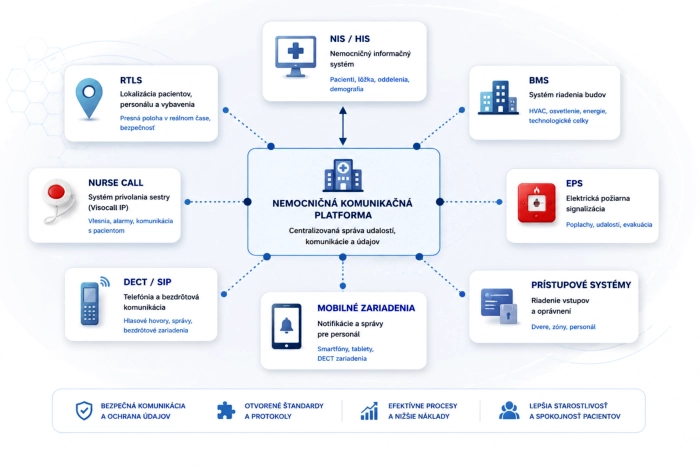
Connecting HIS, Nurse Call, Visocall IP, RTLS, BMS, DECT, SIP, fire alarm systems and other technologies reduces duplicate data entry, improves operational visibility and creates a foundation for the modern digital hospital.
CONNECTED HOSPITAL
Hospital systems integration is the process of connecting separate information, communication and technology solutions through available communication interfaces. This allows individual systems to exchange selected data, notifications, alarms and operational events securely.
In practice, this may include connecting the Hospital Information System (HIS) with Nurse Call, automatically routing events to DECT or SIP phones, adding location data from RTLS or transferring technical notifications to the BMS.
The objective is not to create another isolated system, but to unify the flow of information so that the right data reaches the right people at the right time.
Synchronisation of selected data about the patient, bed, room, ward, event or current system status.
Automatic transfer of notifications and events without unnecessary manual re-entry of information.
Relevant information displayed in the interface used by staff in their day-to-day work.
The ability to connect additional technologies according to available protocols and the requirements of the healthcare facility.
INTEGRATED TECHNOLOGIES
The scope of integration is always designed according to the technical capabilities of the equipment, available interfaces and the operational requirements of the hospital or other healthcare facility.
Transfer of selected data about the patient, bed, room, ward or admission status to other systems.
Connection of call events, nursing stations, patient terminals and mobile staff communication.
Adding the real-time location of patients, staff or medical equipment to events.
Transfer of technical and operational notifications to central building supervision.
Routing events, messages and calls to mobile or desk communication devices used by staff.
Integration of selected events from fire alarm systems, access control, CCTV, signalling and other safety and security technologies.
IMPLEMENTATION PROCESS
Successful integration begins with a thorough understanding of operations, available interfaces and required workflows. Every connection is therefore designed individually.
We define which systems are to be connected, what data will be transferred and who needs to use it.
We review supported protocols, APIs, communication gateways, network infrastructure and system documentation.
We design data flows, event logic, user permissions, logging methods and security measures.
We configure the integration links and verify functionality, data accuracy and responses under fault conditions.
We prepare documentation, train users and provide ongoing support, diagnostics and further integration development.
PRACTICAL SCENARIOS
Integration scenarios are designed around the workflows of healthcare staff, the IT department and facility management.
Selected data from the HIS can be displayed in the hospital communication system without repeated manual entry.
Calls, technical notifications or alarms can be sent according to priority to a workstation, DECT handset or SIP device.
RTLS can add the current location of a patient, staff member or medical device to a notification.
Faults and operating states can be transferred to the BMS or another facility-management supervision system.
If an event is not acknowledged within the defined time, it can be sent automatically to another staff member or team.
Records of events, acknowledgements and response times support operational supervision and process optimisation.
KEY BENEFITS
Well-designed integration reduces manual tasks, improves information availability and helps individual departments work together faster and more accurately.
Data is entered in the source system and made available to other authorised technologies as required.
Automatic event routing helps deliver information to the appropriate staff member without unnecessary delay.
Healthcare and technical staff gain a contextual overview of system status and events.
Reducing manual data re-entry lowers the risk of inaccuracies and inconsistencies between systems.
The modular architecture allows new wards, devices and integration links to be connected gradually.
Connected technologies create a foundation for automation, analytics and the further development of digital services.
TECHNICAL ARCHITECTURE
The choice of technical solution depends on supported interfaces, required availability, the scope of transferred data and the healthcare operator’s security policy.
Data exchange through interfaces provided by the manufacturers or suppliers of individual systems.
Use of available standard or manufacturer-defined protocols according to the specific technology.
Supported systems can use standards designed for the exchange of selected clinical and administrative data.
IP communication enables systems to be connected through the healthcare facility’s managed network infrastructure.
Access to data and functions is configured according to the roles, responsibilities and rules of the organisation.
Event logging and technical diagnostics support functional checks, maintenance and fault resolution.
SECURE OPERATION
Hospital integration processes operational data and, in some cases, personal data. Security measures are therefore designed according to project scope, the nature of transferred information and the operator’s policies.
Only the data required for a specific operational or technical process is transferred between systems.
Separating systems and communication zones helps limit unauthorised access and the spread of faults.
User and system access is managed according to defined roles and responsibilities.
Where supported by the technologies used, secure communication channels and system authentication can be applied.
Records of transfers, faults and interventions support operational control, diagnostics and evaluation.
Functional testing and up-to-date documentation are essential for reliable operation and safe implementation of changes.
COMPREHENSIVE SOLUTION
Systems integration forms part of a broader solution for hospital communication, location services and digital infrastructure.
Safe staff calling, voice communication, signalling and event logging on the ward.
Learn more about Nurse Call →Connection of HIS, Nurse Call, RTLS, BMS, telephony and other technologies within a coordinated solution.
Real-time location of patients, healthcare staff and equipment for safer and more efficient operations.
Learn more about RTLS →A modular Schrack Seconet platform for hospital communication, Nurse Call and technology integration.
Learn more about Visocall IP →WHY SYMATEC
Hospital systems integration requires technical expertise, an understanding of operational processes and cooperation with multiple suppliers. SYMATEC provides a coordinated approach from initial analysis through to ongoing support.
We assess available systems, communication interfaces, network infrastructure and the requirements of individual departments.
We design the architecture, data flows, event processing and communication between systems.
During implementation, we cooperate with the IT department, designers, facility management and suppliers of the connected technologies.
We verify functional scenarios, data transfer, fault conditions, user permissions and system responses.
We provide technical documentation and train users as well as staff responsible for operating the solution.
We provide diagnostics, maintenance, modifications to integration links and system expansion according to future needs.
FAQ
Answers to common questions about connecting HIS, Nurse Call, RTLS, BMS, telephony and other hospital technologies.
Hospital systems integration means connecting separate technologies and information systems so that they can securely exchange data, events and commands. The aim is to simplify staff workflows, reduce duplicate data entry and improve operational visibility.
Depending on the technical capabilities of the project, integration may include the Hospital Information System (HIS), Nurse Call, RTLS, BMS, DECT and SIP telephony, fire alarm systems, access control, CCTV and other building technologies.
A HIS is a Hospital Information System. With a suitable integration interface, it can provide data about the patient, bed, room, ward or admission status. The scope of transferred data is defined according to project requirements, available interfaces and data protection rules.
The connection allows selected patient, bed and ward data to be synchronised and displayed in the hospital communication system. The specific integration method depends on the interfaces supported by both systems.
Yes. Depending on the configuration, events from the Nurse Call system can be routed to mobile terminals, DECT handsets, SIP telephony or other communication devices used by healthcare staff.
RTLS integration can add the location of a patient, healthcare worker or item of equipment to an event. This helps staff find people or devices more quickly and supports better operational organisation.
Integration with the Building Management System (BMS) allows selected operational and technical events to be transferred to central supervision. Staff can therefore gain a better overview of technology status and fault notifications.
Yes. Integration can be designed in stages according to the refurbishment schedule, existing infrastructure and hospital operating constraints. An initial analysis of the systems and available communication interfaces is essential.
The protection method depends on the technologies used and the operator’s security policy. The design may include access control, network segmentation, secure communication channels, event logging and separation of sensitive systems.
Yes. SYMATEC provides consultancy, requirements analysis, integration architecture design, project planning, implementation, configuration, testing, documentation, training and ongoing support.
INTEGRATION ANALYSIS AND DESIGN
We assess existing technologies, available communication interfaces and healthcare workflows. We then design the connection of the HIS, Nurse Call, RTLS, BMS, DECT, SIP, fire alarm systems and other technologies.
We provide project planning, supplier coordination, configuration, testing, documentation, integration commissioning and ongoing technical support.